

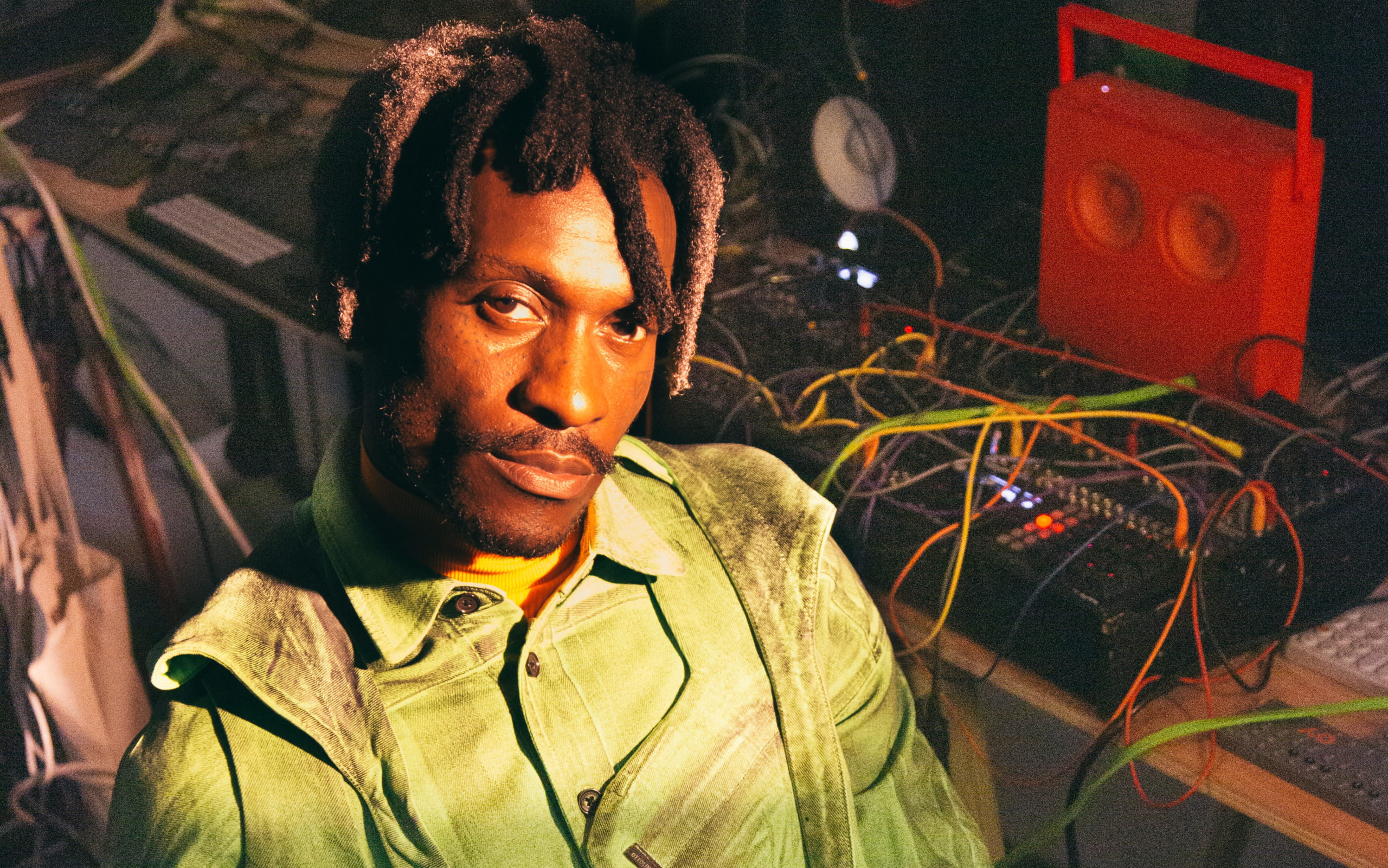
Kirikoo Des
words by w0rmw00d.
There are some people who give you the sense that their body is thinking faster than their words. Where the way they move through a room, a city, a lifetime says more than any neat bio line ever could.
NSDOS, real name Kirikoo Des, is one of those people for me.
He introduced himself to me the way he introduces himself to the world:
“NSDOS, aka Kirikoo Des. I am Musician, Performer, Researcher and Dancer.”

It is tempting to read that as four separate roles. The longer we spoke, and the deeper I went into his work, the more it felt like one continuous state of being. Movement is never just choreography. Sound is never just background. Technology is never just a neutral tool. For him, they are all the same question being asked from different angles.
Born in Paris in 1984, he has grown into a hybrid artist whose work bridges dance, music, technology and digital art. After studying at the International Dance Academy in Paris, he began to develop a language where the body and movement are not just accompanied by sound, but generate it. By capturing what he calls living data, gestures, environmental signals, biological rhythms, through sensors and custom devices, he transforms raw movement into immersive sonic matter.
Our conversations moved across continents as casually as he does: the streets of Paris, Berlin studios, research labs in France, festival stages in Mexico and Tokyo, landscapes in Alaska, future collaborations in Indonesia that were stalled by a pandemic. Not as a travel flex, but as a map of movement itself. Movement, and the relationship between bodies and technology, has been his through line from the very beginning.
Kirikoo’s story lives in the friction between body and machine. He does not just dance to music. He asks what happens when movement writes the score, when the body and the code are forced to share a nervous system.
THE EARLY DAYS
Before there were sensors, before there were custom built instruments and live coding performances, there was just a kid dancing in Paris.
Kirikoo started out as a hip hop dancer on the streets, that particular blend of style, precision and bravado you only really get when the concrete is your first stage. That path eventually led him to formal study at the International Dance Academy in Paris. Technique sharpened, discipline arrived, but one question kept creeping in from the edges:
Who is really in control here, the music or the body?
Most dancers learn to adapt themselves to the beat. You accept that the track is given, external, immutable, and you carve your movement into the spaces it leaves you. At some point, that was not enough for him. He began to feel that his movements demanded their own sonic world, one that did not exist yet.
After studying dance, he felt the need to create his own sound in order to explore movement. From there, he started imagining a whole new sonic order, an alternative approach to music, through abstraction.
That phrase, a whole new sonic order, says a lot. He was not content to be another dancer over someone else’s four to the floor. He wanted to rearrange the hierarchy entirely. Instead of music first, movement second, his work starts from the body and radiates outward, asking what music has to become in order to keep up.

Paris was where this shift began. Berlin was where he stress tested it. He talks about the city as a giant laboratory, a place where he could treat clubs, studios and galleries as test rigs, pushing his questions about movement, sound and technology into the field of possibilities.
MOVEMENT, MACHINES AND MATTER
The French press has called him a hacker of techno. It sounds like a slogan until you see how literal it is.
NSDOS does not restrain himself to existing technological tools and software. He prefers creating his own mediums: futurist instruments made from old audio converters, Gameboy emulators, cables and pieces of metal dismantled and welded together into surreal machines. Surrounded by these hybrid tools, he unravels what he calls the rectilinear anatomy of techno. Textures are exploded, sounds mutilated and then brought back to their essence.
He ranks among his icons artists who also mess with the boundaries between body, machine and media: experimental sound artists, body hacking performers like Stelarc, thinkers like Donna Haraway who insist that we take cyborg realities seriously. You can feel that lineage in the way he works. He is Dada and DIY in the deepest sense, taking the materials of his time, consoles, sensors, software, and bending them somewhere they were never meant to go.
A big part of this practice lives in how he uses code. NSDOS is a prominent user of ORCA, an open source procedural sequencer and livecoding environment for music, visuals and generative art. ORCA runs on a grid of text based commands, each letter acting like an operation that sends and manipulates data in real time, talking to tools like Ableton, SuperCollider and modular systems. For someone who treats movement as data and data as movement, it makes perfect sense. He is literally writing choreographies for machines, one character at a time, and letting those structures be driven by signals coming off bodies and environments.
His creative path is empirical, sometimes almost biological. He will put sensors on insects, on trees, on his audience in trance, everything that comes his way, and transcribe those movements into sound. The line between environment and instrument starts to blur. Is he sampling the world, or is the world sampling him?
On stage, this becomes a ritual between body and machine. Sensors strapped to limbs. Interfaces that would not make sense to anyone else. Data flowing from skin to code to speaker cone. The kick drum still hits, but it feels less like a preset and more like something breathing.
One of his most striking performances involved a customized tattoo gun routed into his setup. Each impact of needle on skin triggered sound. Pain, ink, electricity, music, all the same circuit.
“That was not so much about the act of tattooing,” he told me, “but about electronic musicians. At what point does he engage his body, especially when there are interfaces, keyboards and knobs? The body touches things but is not affected. I wanted to see at what point I am affected by my own performance, and what remains of it. I still bear the physical signs of this performance.”
There is something quietly radical about that. So much electronic music happens at a safe distance: fingers on plastic, eyes on a screen. The body is the operator, not the site of consequence. By wiring his own skin into the system, he collapses that distance. The performance does not end when the PA is turned off; it lingers as a scar, a memory, a trace.

He likes to say he does not simply create; he regenerates and transmutes music. Take something fixed, feed it through movement, biology, error and time, and see what comes out the other side.
INTUITION, CLUBBING SEQUENCE AND MICRO CLUB
If you follow his records, you start to see that he is less obsessed with dance in the narrow sense and more with systems of movement. Crowds in a club, yes, but also landscapes, weather, traffic, everyday gestures.
After a run of early releases, Lazer Connect (2013) and Female Guest (2015) on ClekClekBoom, Money Exchange (2016) on his own Standalone Complex label, he put out Intuition in 2017, followed by Intuition Vol 2 in 2018. These records feel like the completion of a first cycle of his practice: movement, biology, techno and abstraction braided together. Intuition was composed partly outdoors in Alaska, using meteorological data gathered from the environment and folded back into structured rhythmic patterns.
Inspired by meteorological stations and principles of biofeedback, he surveyed the movements of nature, turned them into data and then translated that data into sounds, textures and rhythms. The album was accompanied by a series of videos showing the full process, from recording in the middle of nature to the translation work in the studio.
In Intuition, techno is not a genre so much as a matrix, a skeleton that can hold other forces. You can hear his sense of discipline, drawn partly from his passion for Japanese Butoh, a dance form obsessed with slowness, intensity and the transformation of the body. You can also hear his interest in biology, in cycles and feedback loops. Industrial and almost metal like sounds creep in around the edges. It is unclassifiable by design. The point is to push the frontiers, not sit inside a category.
The same questions run through Clubbing Sequence, where he synchronizes the movements of dancers with live electronic modulation in an augmented club environment. The club becomes a feedback loop: bodies affect sound, sound affects bodies, and the distinction between crowd and instrument starts to blur.
Then the pandemic hit, and with it came a different kind of experiment: a world where movement was suddenly constrained, restricted, almost illegal.
His album Micro Club, released in 2021, came out of that period. He describes it as “an exploration of the body within the sometimes extremely restrictive context of lockdown, with movement, and especially dancing, reduced to a bare minimum.”
If the traditional club is huge systems in motion, lights, sound, sweat, strangers, Micro Club feels like the opposite. The club shrinks down to the size of a living room, or a nervous system. The tracks carry this compressed energy, like someone trying to dance full out inside a very small box. You can feel the pressure between the desire to move and the social conditions that will not quite let you.
Across all of these projects, there is a recurring question: how much of dance can you remove before it stops being dance? What if movement is data on a hard drive? What if the club exists more as a system than a place?
POST INTERNET DANCE AND S.E.L.M.
This brings us to what might be the most explicitly philosophical part of his work: S.E.L.M., Send Everyday Life Movement, the research and creation project he developed with Villa Albertine.
“In my work,” he writes, “I explore the relationship between the physical and the virtual, examining the technologies that enable such connections. For instance, I have been collaborating with the technological innovation institute, MATRICE, to consider the possibility of a post Internet dance fueled by a decentralized database of movements.”
The phrase post Internet dance sticks with me. We talk a lot about post Internet art in galleries and online spaces, but here the proposal is that even dance, something we imagine as the most grounded, embodied of practices, can be reconfigured around networks and databases.
“For my research and creation project at Villa Albertine, my core aim will be to investigate how technology can augment the body of a dancer, and how it might allow for simultaneous performances in both virtual and physical spaces.”
He imagines capturing and automatically looping movements into a vast library, a database of captured, automatically looping movements. Then he asks a series of unsettling questions.
If we build that database, at what point can the dancer’s body be omitted from the equation entirely? Conversely, how might the dancer’s physical form re embody such a profoundly inert archive? Can technology exist without us? And if not, how do we appropriate it, give it form again, insist that it remembers where it came from?
“Embedded in this American polemic,” he notes, his work “studies the possibility of creating a bodiless dance through the compilation of captured movements, and of rehumanizing data into movements that augment the dancer’s choreographic palette. I plan to set up a network of decentralized sensors to record the movements of thousands of individuals, which will then be made available to my own body.”

There is something almost sci-fi in that image: a single body carrying the echoes of thousands of others, a dancer becoming a sort of living playback device for a distributed archive of everyday gestures. But the point is not spectacle; it is investigation. How far can we abstract movement before we lose its humanity, and how might we bring that humanity back?
In New Orleans, this idea becomes very concrete. He wants to work on capturing and duplicating gestures to build a database, which he will then use to create dance performances. He talks about connecting with Social Aid and Pleasure Clubs, local dancers, university researchers, testing their palate for hybrid performances that combine live coding, club energy and this question of what a post Internet dance could be.
ACTIVATE CITIES
His most recent project, Activate Cities, takes all of these ideas and walks them directly into the streets.
The project was born from a meeting with author Noam Assayag, whose essay offers both a philosophical and practical reflection on ambulatory art. Starting from the observation that cities are increasingly reduced to purely utilitarian functions, Assayag asks how we might reactivate their emotional and poetic potential through itinerant artistic experiences. Activate Cities grows out of that question, encouraging a new relationship with urban space.
This vision immediately resonated with NSDOS, whose sonic practice has always treated the environment as a living, three dimensional organism. Having begun with bodily movement, he has for years been exploring the dynamic nature of space itself. Even his recent EPs, with titles like //champignonner.photometaque.ultrasonique, embody this spatial thinking, using GPS coordinates as compositional material. The album Activate Cities is conceived as a musical extension of Assayag’s book, a bridge between theory and creation, a dialogue between writing and composition. For the release, the book is reissued and expanded with the sonic and visual contributions of NSDOS.
Taking the work into public space, NSDOS imagines an immersive and multisensory path through the three cities where the project was born: Paris, Berlin and Athens. Metal QR codes are embedded into the urban landscape, letting passersby access sounds from the album on their phones and creating a shifting sonic map through often overlooked or invisible neighborhoods. Each listener activates a different route, a different reading of the city, and becomes an actor in a renewed, sensitive connection to their environment.
Activate Cities expresses a simple but powerful intent: to re enchant the commons through art and music, to invite a way of experiencing the city that is more poetic, more attentive, more free. It is NSDOS taking his long standing obsession with movement, data and bodies, and applying it not only to individual dancers or club crowds, but to the living organism of the city itself.
AI, NEUTONE AND NEW TOOLS
Given all of this, it felt almost inevitable that our conversations would drift toward artificial intelligence, new tools, and the questions they raise.
My own entry point into this world is through Neutone, an AI based audio tool that focuses on timbre transfer and real time sound transformation. In some circles, AI in music is framed as a threat: something that will replace human creativity, automate away the need for bodies and practice. Sitting with Kirikoo, that framing felt almost absurdly narrow.
For an artist who has spent years translating movement into data and data back into movement, AI is not a rupture so much as a continuation. It is another way to map signals between bodies, environments and machines. Another way to test how far you can stretch the relationship between impulse and sound.
When we spoke about Neutone and similar tools, what interested him was not the novelty of the technology but the use cases that most people might overlook. How could a model trained on specific timbres or performance habits become a dialogue partner rather than a shortcut. How might AI based processing sit inside the same ethical and aesthetic questions he is already asking about data, ownership and rehumanization.
There is also a deep resonance between his insistence on consent and trace, and the emerging conversations around AI training and artist rights. The idea that models should be built from data that is shared willingly, that creators should see and feel where their work goes, fits naturally beside his tattoo gun performance or his S E L M research. In all of these cases, the body leaves a mark and receives one back.
I will not try to summarize every tangent we went down here. This is the section where our chat on Neutone, AI and technology really lives. But what stayed with me was his calm refusal to panic. For him, the important thing is always the process of exploration. New tools, whether they are motion sensors, live coding environments or AI audio models, are invitations to go deeper into the unknown, not to avoid it.

TECHNOLOGY, BODIES AND THE FUTURE
The “Where” of these projects is just as important as the “What.”
“Why travel to the United States? Because of technology!” he writes. “It was here that people started reflecting on dematerialization, as embodied most prominently by the Internet. I want to carry on this story of American engineers and scientists, but also highlight France’s part in the Internet’s origin story, and remember the warnings from the hippie movement about technological misuse, all with a view to strengthening ties between France and the United States.”
There is a quiet historical awareness in that answer. He is not just dipping into tech culture because it is fashionable. He is placing his work into a lineage: engineers pursuing dematerialization, countercultures warning against misuse, artists trying to process the fallout.
He is also very clear that this is not just aesthetic; it is political.
“The issue of data rehumanization also carries a political dimension. Our societies are divided. With MATRICE’s François Xavier Petit, we investigate the role that technology played in this split. How much do the American and French middle classes feel that their lives are dispossessed by encroaching technical systems that have advanced beyond all comprehension?”
That line, lives dispossessed by encroaching technical systems, lands hard if you have spent any time talking to people about AI, automation, algorithms. What he is probing in post Trump America, in this society built on a computer mainframe, is not just what technology can do, but what it has already done to people’s sense of agency and belonging.
“In my efforts to rehumanize data by giving it a new body through dance movements, I will necessarily reflect on technological accessibility, understanding, and, fundamentally, appropriation. The project involves an ethical reorientation of technology, which must now understand itself as a genuine social phenomenon.”
I find this incredibly important. We are used to hearing about ethics in tech from policy papers, open letters and corporate statements. Here, ethics appears in a completely different form: as choreography. As a dancer in New Orleans, building a database from everyday gestures. As live coding in front of a club crowd. As sound walking through streets in Activate Cities and asking you to listen differently.
THE TRACE THAT REMAINS
When I step back and look at Kirikoo’s work as a whole, I do not just see a resume of projects, festivals and residencies. I see a long, patient investigation into one question.
What remains of us in our technologies, and what remains of our technologies in us?
From the streets of Paris to the International Dance Academy, from Berlin’s giant laboratory to meteorological stations in Alaska, from hacked machines and tattoo guns to micro clubs in lockdown, from decentralized movement databases to dance experiments in New Orleans, from post Internet choreographies to walks through activated cities, NSDOS keeps returning to the same loop. Capture, abstract, loop, re embody. Strip movement down to data, then insist on giving that data a body again.
There is a version of this story where he becomes just another “multidisciplinary artist” buzzword salad: dancer, performer, researcher, technologist. That is not what I encountered in his work. What I find instead is someone stubbornly curious, willing to let his own body be the testing ground for questions most of us only entertain in theory.
Our era is full of systems that want to dematerialize us into users, into metrics, into training data. NSDOS reminds me that we can push back, not just by writing essays or passing laws, but by moving. By letting the body touch the machine and be touched back. By insisting that even the coldest, most inert databases can be rehumanized, one gesture at a time.
He still bears the physical signs of his performances. The rest of us, if we are paying attention, might end up carrying a few traces of them too.
—o—

NSDOS’s latest project, Activate Cities (2025), expands his artistic vision into the urban realm. Created in collaboration with writer Noam Assayag, the album and accompanying book explore how art can reawaken our sensory connection to the city.
Built around six tracks, Activate Cities translates theoretical reflections on “ambulatory art” — art that moves through and activates urban space — into sound. Through environmental recording, movement sensors, and digital synthesis, NSDOS reimagines the city as a living organism, where rhythm and architecture, sound and movement, merge into a shared ecosystem.