

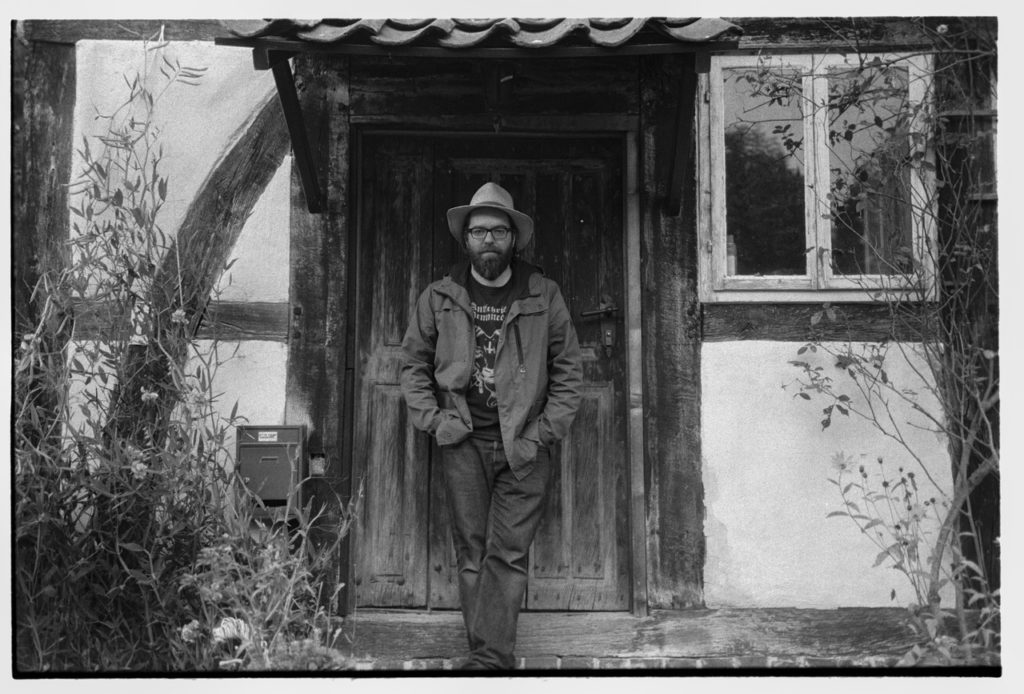
Michael Beckett
Photo credit to Thorsten Runge
Michael Beckett has a way of working that feels almost stubborn in the best sense. He commits early. He makes decisions while the sound is still warm. He lets the process leave fingerprints. The result is music that feels less like it was assembled and more like it was captured, shaped in real time, then released into the world without being overprotected.
A lot of this comes down to one simple preference: keeping things physical. Not out of nostalgia, and not as a rejection of modern tools, but because the body matters. The hands matter. The friction matters. When those things disappear, the work can start to feel like administration.
THE EARLY YEARS
Beckett was born in Germany in 1973, moved to the u.k. in 1980, then returned to Germany in late 1987. His first relationship to music is listening, and it begins with family records and a child’s determination to get the machine working.
“My dad had lots of records back then… family lore has it that I taught myself how to use the record player to listen to the propaganda album by Sparks… I must have been around 3. I find it’s still a banging album to this day.”
He describes himself as a kid drawn to music, but initially on the more mainstream side, until a single compilation shifted his entire sense of possibility.
“I was always into music but the more top 40 side… until 87 when I got the substance singles comp from new order… that put me on a trajectory which would ultimately go on to ruin my life.”
What matters is the shift in imagination. He did not grow up assuming he would make records, or that he belonged to the category of “people who release music.”

“no, I never, ever thought I would make let alone release music… that was some weird next level magic shit other people did.”
HOW MAKING STARTED TO FEEL POSSIBLE
There’s a kind of accidental honesty in the stories he remembers. One is pure childhood chaos, rhythm as instinct, the earliest version of a percussive mantra.
“Again family lore… One day I came home from kindergarten, grabbed a bucket and a stick and started beating the bucket shouting : scheiße, scheiße, scheiße… meaning shit, shit… (I was not in the slightest a ‘rebellious’ child).”
He laughs about it now, but there’s a serious undertone in what he says next. It’s half joke, half diagnosis of the moment we are living through.
“I sometimes think about recording this with everyone I know on vocals… about the only lyrical content necessary in these times, I’d say.”
The studio version of that “something is happening here” feeling arrives later, in the mid 90s, when recording stops being documentation and becomes space, depth, a new kind of image.
“What I do remember being an amazing feeling was getting my first 4 track (the beautiful Tascam 246) and adding a 2nd guitar to the first guitar I had recorded… and then panning them left and right… mindblowing.”
He places it around 95ish, while he was in a band but before he had ever been in a studio, and he describes it as a rare glimpse of a future he did not usually plan for.
“i’ve never been one to plan ahead but this was a very, ‘I could see myself doing more of this’ moment.”
BANDS, TOURING, AND LEARNING THROUGH OTHER PEOPLE
By 1997 he released an album with an indie rock band called Tuesday Weld. It’s one chapter in a bigger story, the slower construction of an ear through proximity, touring, improvisation, and obsessive listening.
Touring as part of the Schneider TM Experience mattered because it wasn’t just performance, it was constant practice, and a kind of shared research lab around music.
“Live we improvised a lot, recorded lots and listened to and talked about music all the time… discovering everything together. it was exciting as fuck and I took a lot away from the experience.”
He also describes a habit that feels like deliberate self-training. He used to listen to things he didn’t like, not to prove a point, but to understand the mechanics of taste from the inside.
“I also used to make a point out of listening to stuff i didn’t like… trying to find good bits in it, figuring out what i didn’t like about it, that sort of thing. I don’t need to do that anymore but that also kind of helped along the way.”

Photo Credit to Elvis Nass
WHY OLD RECORDINGS PULLED HIM IN
Beckett keeps returning to rawness, not as an aesthetic pose, but as something he trusts. He talks about getting into old blues through very specific library CDs from the wolf label, compilations focused on narrow windows of time and place.

“I got into weird, old blues through a bunch of CDs I got from the local library. The label was called wolf, from Austria, i think. they were very specific comps… some random small town, Mississippi, 1929-1931… that kind of thing. I found the rawness, weirdness and beauty of this music fascinating.”
“I was then given Harry Smith’s Anthology of American Folk Music for my 30th and it really blew me away. The weirdness is so real (for lack of a better word)… no pretending. and again raw, intense, often beautiful and often primitive in the best ways.”
And then he says the line that every musician recognizes in their bones, the moment you hear something so alive it makes your own work feel unreal for a second.
“It makes you feel like a complete hack.”
He also points to the way this music carries migrations inside it, old-world traces living inside new-world sound.
“Another interesting aspect of the music was that you can kind of guess which parts of the old world it originally came from.”
FINISHING, SPEED, AND THE VALUE OF LIMITS
He used to tweak forever. Now he’s learned to finish, and he credits both age and the reality of limited gear for making him clearer about what he wants.
“Yes… I used to tweak things forever but I’ve gotten much, much better and know what i’m going for… I guess that comes with age and probably also the limited gear I have at my disposal.”
That clarity turns into something like athletic discipline on projects like Leuder van Frohr, partly because the scale forces decisions.

“The Leuder van Frohr thing was like an extreme sport kind of situation I put myself in… 80odd tunes I wanted to rework… so I had to work fast.”
His method was direct and ruthless in a way that actually protects momentum. Often he would move quickly and print the result rather than opening up endless options.
“I banged the whole thing out pretty fast, sometimes doing 5 tracks in a 3 hour sitting and just recording the stereo signal… no multitrack.”
He’s also clear that constraint is not a magic wand. Some tracks still took ages, but the broader approach kept the project moving. He also chose to rework the material in the same order as the original.
“There were certain tracks which took ages though. The whole thing was done in the same order as the original.”
He contrasts that intensity with jukebox classics, a project based on a gift of records from his uncle.
“Have you checked out the jukebox classics? That’s 114 tracks which were reworkings of the 7″ my uncle had in his jukebox in the 80s and early 90s (he used to have pubs in the u.k.). That was way easier to make than Leuder because I actually used a sampler (1010music blackbox).”
MIXING AS A SIGNAL PATH
That same philosophy shows up clearly in how he mixed anthology. Instead of building a session designed for infinite revision, he treated the mix like a performance chain. The gear list is telling, because it reads like instruments rather than utilities.
“I used a mixing desk, Kaoss pad 2, a spring reverb tank salvaged from a cheap amp which was destroyed for an art project, a Korg ms2000 (used as a filter) and a bunch of guitar pedals (including a looper).”
Then he committed it as a single printed moment, which is both a technical choice and a psychological one.
“The tracks were recorded to logic as a single stereo track.”
TECH, MISUSE, AND AI AS A MOOD PROBLEM
When Michael talks about technology, he doesn’t romanticize the past, but he defends the value of misuse. He points out that a lot of forward motion came from people abusing gear, not fully understanding it, and making something anyway.
“Amazing stuff came out of gear abuse, not knowing how to use gear, hell… not even knowing how to play guitar or any other instrument for that matter. that is (was?) often where it was at.”
On AI, he’s careful to say he is speaking personally and emotionally, without pretending expertise, and that he still hasn’t reached a conclusion. Where he’s at right now is blunt. It doesn’t interest him. Part of that is the larger atmosphere around the tool, the sense that its mainstream uses don’t feel humane or hopeful to him.

“Regarding AI, I can only speak for myself here… as I’ve mentioned before it’s my emotional and misinformed view on the matter. I’ve not come to a full conclusion on my thoughts regarding AI (in music/art) but at the moment it does nothing for me. I dunno… I guess the future isn’t looking too bright at the moment and that probably has something to do with why it’s such a turn off for me… the mainstream use of AI (at the moment) doesn’t seem to be much of a benefit to humanity. more like the opposite…”
He names the darker edge without embellishment, then landing on the most honest answer possible.
“On the other hand… weird fucking armed dog drones… let’s combine those with AI and see what happens… scary shit. To be honest, the topic is way too complex for me so this is my rather simplistic take on the matter. So to answer your question: I don’t know but it’s not for me.”
NEUTONE, SAMPLING, AND THE ETHICAL GREY
Michael understands Neutone’s intent and doesn’t dismiss it. But he keeps circling back to complexity, especially the gap between legal and right. He sees the tool as closer to sampling, which he’s open to, and immediately points out that sampling is also full of unresolved ethical knots.

“I understand where you guys are coming from and I’m down with that… but it’s all so complicated. I do see your tool more akin to sampling, which I am also down with… but even that in itself is… complicated.”
He gives an example that captures the tension between public domain and human labor. Even if the recordings are legally usable, it can still feel off to reduce a lifetime of mastery into a usable dataset.
“Now they may be public domain and with that it is legal to train your model using that information… but that kind of foregoes the fact that the guy was a master of his instrument, took ages to technically get where he was bladibla… for me it feels slightly off.”
Then he catches himself and laughs, because he knows he’s speaking from inside contradiction, not outside it.
“All this coming from the guy who reworked the anthology.”
JAN, FAITICHE, AND HOW THESE WORLDS CONNECT
Beckett met Jan Jelinek around 2004, then ran into him occasionally in Berlin. Two atoms in orbit coming back together over time.
“We met around 2004 in Bilbao when I was a touring member of the Schneider TM Experience. We hung out and after that would meet occasionally in Berlin at shows.

About 5 years ago I ordered loop finding jazz records for my son from the Faitiche Bandcamp. Jan recognised my email address and got in touch (we hadn’t been in touch for a while at this point)… he asked for links to stuff I’d been up to and offered to release a collection of tracks from Leuder, which had originally come out in a 3 cassette edition.”
LOOKING AHEAD
Michael not in a phase of big announcements. He’s in a phase of making things because they need to be made.
“Not much at the moment, to be honest.”
But there is plenty moving under the surface, a few projects that feel playful, and a few that feel like a return to raw materials.
“I’m working on a Christmas tune with the upland band. I’m also working on an album of no-fi field recordings, made with a sanyo talkbook (handheld mini cassette dictaphone) and a bunch of trip shrubb stuff is waiting to be made.”
“My friend Giant Fox and I are planning on making a short movie which uses raw footage of a nightclub in Toulon (south of france) from the mid 70s… absolutely amazing raw footage.”
On releases and shows, nothing is fixed, but nothing is closed either.
“As far as physical releases are concerned there doesn’t seem to be anything upcoming but you never know… same with shows.”
And the closing thought returns to the emotional center of the whole conversation, the thing that sits beneath the process, beneath the gear, beneath the skepticism.
“One thing I was trying to get at in my first answer is that the future used to be a very exciting prospect… now it’s kind of terrifying.”
—o—

You can follow along with Michael and all he has going on below: